Mike Rose Reading From They Say I Say
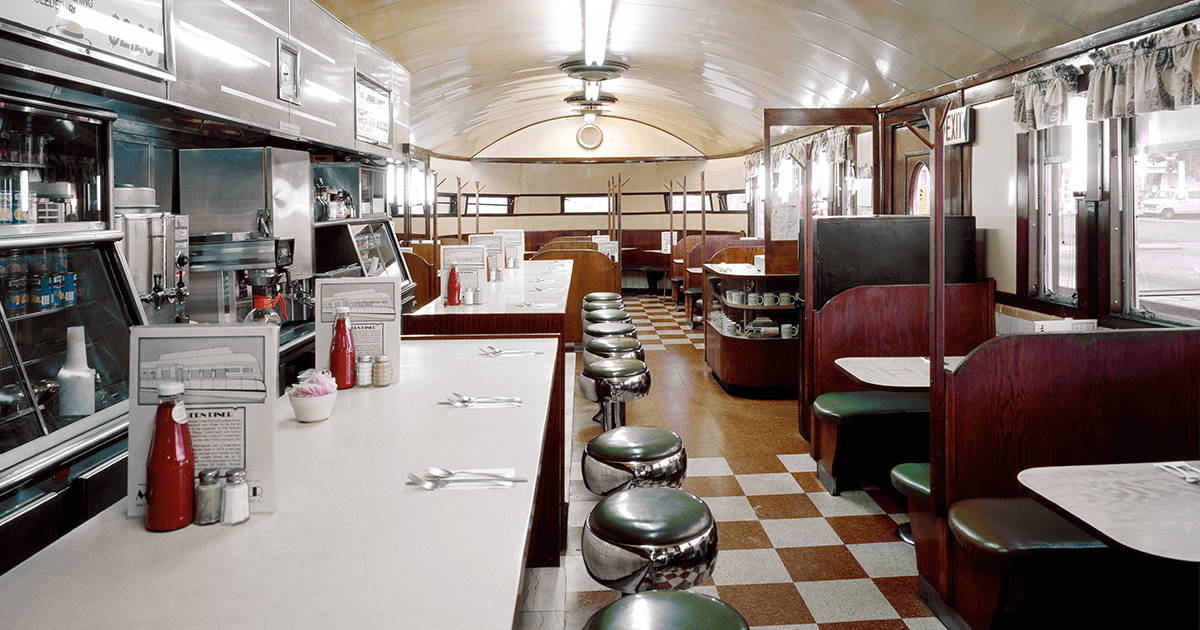
Diner in Pawtucket, Rhode Island (Photograph by Ballad Highsmith/Library of Congress)
My mother, Rose Meraglio Rose (Rosie), shaped her adult identity equally a waitress in java shops and family restaurants. When I was growing upwards in Los Angeles during the 1950s, my male parent and I would occasionally hang out at the restaurant until her shift ended, and so we'd ride the bus home with her. Sometimes she worked the register and the counter, and we sat there; when she waited booths and tables, we found a berth in the back where the waitresses took their breaks.
At that place wasn't much for a child to do at the restaurants, and so as the hours stretched out, I watched the cooks and waitresses and listened to what they said. At mealtimes, the step of the kitchen staff and the din from customers picked upward. Weaving in and out around the room, waitresses warned behind you in impassive but urgent voices. Standing at the service window facing the kitchen, they called out abbreviated orders. Fry iv on ii, my mother would say equally she clipped a bank check onto the metal bicycle. Her tables were deuces, iv-tops, or half dozen-tops according to their size; seating areas also were nicknamed. The racetrack, for instance, was the fast-turnover front section. Lingo conferred say-so and signaled know-how.
Rosie took customers' orders, pencil poised over pad, while fielding questions almost the food. She walked full tilt through the room with plates stretching up her left arm and two cups of coffee somehow cradled in her right manus. She stood at a table or berth and removed a plate for this person, another for that person, then some other, remembering who had the hamburger, who had the fried shrimp, almost always getting it right. She would haggle with the cook almost a returned society and blitz past us, saying, He gave me lip, just I got him. She'd have a minute to flop down in the booth next to my father. I'chiliad all in, she'd say, and whisper something about a client. Gripping the outer border of the table with one mitt, she'd watch the room and note, in the menses of our conversation, who needed a refill, whose order was taking longer to prepare than it should, who was finishing up.
I couldn't have put it in words when I was growing up, only what I observed in my mother's restaurant defined the world of adults, a place where competence was synonymous with concrete work. I've since studied the working habits of bluish-neckband workers and have come to understand how much my female parent's kind of work demands of both body and encephalon. A waitress acquires knowledge and intuition almost the ways and the rhythms of the eatery business. Waiting on seven to 9 tables, each with ii to vi customers, Rosie devised memory strategies so that she could remember who ordered what. And because she knew the average fourth dimension it took to prepare different dishes, she could monitor an order that was taking too long at the service station.
Like anyone who is constructive at physical work, my mother learned to work smart, as she put it, to brand every move count. She'd sequence and group tasks: What could she do first, then second, and then third as she circled through her station? What tasks could be clustered? She did everything on the fly, and when problems arose—technical or homo—she solved them within the flow of piece of work, while taking into account the emotional country of her co-workers. Was the manager in a good mood? Did the cook wake up on the wrong side of the bed? If then, how could she make an extra request or effectively return an social club?
And and then, of course, there were the customers who entered the eatery with all sorts of needs, from physiological ones, including the emotions that back-trail hunger, to a sometimes complicated want for homo contact. Her tip depended on how well she responded to these needs, and and so she became adept at reading social cues and managing feelings, both the customers' and her ain. No wonder, and so, that Rosie was intrigued by psychology. The eating house became the place where she studied human behavior, puzzling over the problems of her regular customers and refining her ability to deal with people in a difficult world. She took pride in being among the public, she'd say. There isn't a 24-hour interval that goes past in the eating place that yous don't learn something.
My mother quit school in the seventh grade to assist raise her brothers and sisters. Some of those siblings made it through loftier school, and some dropped out to discover piece of work in railroad yards, factories, or restaurants. My begetter finished a grade or 2 in primary school in Italy and never darkened the school door again. I didn't practise well in school either. By high school I had accumulated a spotty academic record and many hours of hazy disaffection. I spent a few years on the vocational track, but in my senior twelvemonth I was inspired by my English language teacher and managed to squeak into a small higher on probation.
My freshman yr was academically bumpy, but gradually I began to see formal education as a ways of fulfillment and every bit a road toward making a living. I studied the humanities and later on the social and psychological sciences and taught for 10 years in a range of situations—unproblematic school, adult educational activity courses, tutoring centers, a program for Vietnam veterans who wanted to go to college. Those students had socioeconomic and educational backgrounds like to mine. Then I went dorsum to graduate school to study teaching and cerebral psychology and eventually became a kinesthesia member in a schoolhouse of educational activity.
Intelligence is closely associated with formal education—the type of schooling a person has, how much and how long—and most people seem to move comfortably from that notion to a belief that piece of work requiring less schooling requires less intelligence. These assumptions run through our cultural history, from the post–Revolutionary War period, when mechanics were characterized by political rivals as illiterate and therefore incapable of participating in government, until today. More one time I've heard a manager characterization his workers as "a bunch of dummies." Generalizations near intelligence, work, and social form deeply bear upon our assumptions nearly ourselves and each other, guiding the means we utilise our minds to acquire, build cognition, solve problems, and brand our way through the world.
Although writers and scholars have oft looked at the working grade, they have more often than not focused on the values such workers exhibit rather than on the thought their piece of work requires—a subtle but pervasive omission. Our cultural iconography promotes the muscled arm, sleeve rolled tight against biceps, but no effulgence behind the eye, no image that links paw and brain.
I of my mother's brothers, Joe Meraglio, left school in the 9th class to work for the Pennsylvania Railroad. From there he joined the Navy, returned to the railroad, which was already in decline, and somewhen joined his older brother at General Motors where, over a 33-year career, he moved from working on the assembly line to supervising the paint-and-body department. When I was a young man, Joe took me on a tour of the factory. The floor was loud—in some places deafening—and when I turned a corner or opened a door, the smell of chemicals knocked my head back. The work was repetitive and taxing, and the pace was inhumane.
Still, for Joe the shop floor provided what schoolhouse did not; information technology was like schooling, he said, a place where you're constantly learning. Joe learned the most efficient mode to use his torso by acquiring a fix of routines that were quick and preserved energy. Otherwise he would never have survived on the line.
As a foreman, Joe constantly faced new issues and became a complete multi-tasker, evaluating a flurry of demands speedily, parceling out physical and mental resources, keeping a number of ongoing events in his mind, returning to whatsoever chore had been interrupted, and maintaining a cool caput nether the pressure of grueling production schedules. In the midst of all this, Joe learned more and more about the auto manufacture, the technological and social dynamics of the store flooring, the machinery and production processes, and the basics of paint chemistry and of plating and baking. With farther promotions, he non but solved problems but likewise began to find issues to solve: Joe initiated the redesign of the nozzle on a paint sprayer, thereby eliminating costly and unhealthy overspray. And he found a way to reduce energy costs on the baking ovens without affecting the quality of the paint. He lacked formal knowledge of how the machines under his supervision worked, but he had directly experience with them, hands-on knowledge, and was savvy most their quirks and operational capabilities. He could experiment with them.
In add-on, Joe learned about budgets and management. Coming off the line every bit he did, he had a perspective of workers' needs and management's demands, and this led him to remember of ways to improve efficiency on the line while relieving some of the stress on the assemblers. He had each worker in a unit of measurement learn his or her co-workers' jobs then they could rotate across stations to relieve some of the monotony. He believed that rotation would let assemblers to go longer and more frequent breaks. Information technology was an easy sell to the people on the line. The wedlock, even so, had to approve whatever modification in chore duties, and the managers were wary of the change. Joe had to argue his case on a number of fronts, providing him a kind of rhetorical education.
Eight years ago I began a study of the thought processes involved in work similar that of my mother and uncle. I catalogued the cognitive demands of a range of blue-neckband and service jobs, from waitressing and hair styling to plumbing and welding. To proceeds a sense of how knowledge and skill develop, I observed experts every bit well as novices. From the details of this shut examination, I tried to fashion what I called "cerebral biographies" of blue-neckband workers. Biographical accounts of the lives of scientists, lawyers, entrepreneurs, and other professionals are rich with particular nearly the intellectual dimension of their work. But the life stories of working-grade people are few and are typically accounts of hardship and backbone or the achievements wrought by hard work.
Our civilization—in Cartesian fashion—separates the trunk from the heed, and then that, for case, we assume that the use of a tool does not involve abstraction. We reinforce this notion past defining intelligence solely on grades in school and numbers on IQ tests. And nosotros use social biases pertaining to a person's place on the occupational ladder. The distinctions amongst blue, pink, and white collars carry with them attributions of character, motivation, and intelligence. Although we rightly acknowledge and amply recoup the play of mind in white-collar and professional work, we diminish or erase it in considerations about other endeavors—physical and service work particularly. We also often ignore the experience of everyday work in administrative deliberations and policymaking.
Merely here'south what we notice when we arrive close. The plumber seeking leverage in club to work in tight quarters and the hair stylist adroitly treatment scissors and comb manage their bodies strategically. Though work-related deportment become routine with experience, they were learned at some bespeak through observation, trial and mistake, and, often, physical or verbal help from a co-worker or trainer. I've frequently observed novices talking to themselves as they take on a task, or shaking their head or hand as if to erase an try earlier trying again. In fact, our traditional notions of routine performance could proceed us from appreciating the many instances within routine where quick decisions and adjustments are made. I'1000 struck by the thinking-in-motion that some piece of work requires, past all the mental activity that can be involved in simply getting from i identify to another: the waitress rushing back through her station to the kitchen or the foreman walking the line.
The employ of tools requires the studied refinement of opinion, grip, balance, and fine-motor skills. But manipulating tools is intimately tied to knowledge of what a particular instrument tin practise in a detail situation and do better than other similar tools. A worker must besides know the characteristics of the fabric one is engaging—how it reacts to diverse cutting or compressing devices, to degrees of estrus, or to lines of force. Some of these things demand judgment, the weighing of options, the consideration of multiple variables, and, occasionally, the creative utilize of a tool in an unexpected way.
In manipulating material, the worker becomes attuned to aspects of the environment, a training or disciplining of perception that both enhances knowledge and informs perception. Carpenters take an middle for length, line, and angle; mechanics troubleshoot by listening; pilus stylists are attuned to shape, texture, and move. Sensory data merge with concept, as when an motorcar mechanic relies on sound, vibration, and even odor to understand what cannot exist observed.
Planning and trouble solving have been studied since the earliest days of mod cognitive psychology and are considered core elements in Western definitions of intelligence. To piece of work is to solve bug. The big difference between the psychologist's laboratory and the workplace is that in the sometime the problems are isolated and in the latter they are embedded in the existent-time flow of work with all its messiness and social complexity.
Much of physical work is social and interactive. Movers determining how to get an electric range down a flight of stairs crave coordination, negotiation, planning, and the establishing of incremental goals. Words, gestures, and sometimes a quick pencil sketch are involved, if merely to go the rhythm correct. How important it is, so, to consider the social and communicative dimension of physical piece of work, for it provides the medium for and then much of work'south intelligence.
Given the ridicule heaped on bluish-collar oral communication, it might seem odd to value its cognitive content. Still, the flow of talk at work provides the channel for organizing and distributing tasks, for troubleshooting and problem solving, for learning new information and revising former. A meaning amount of teaching, ofttimes informal and indirect, takes place at work. Joe Meraglio saw that much of his chore as a supervisor involved instruction. In some service occupations, language and communication are central: observing and interpreting behavior and expression, inferring mood and motive, taking on the perspective of others, responding appropriately to social cues, and knowing when you're understood. A good hair stylist, for example, has the ability to convert vague requests (I want something lite and summery) into an appropriate cutting through questions, pictures, and hand gestures.
Fiveerbal and mathematical skills bulldoze measures of intelligence in the Western Hemisphere, and many of the kinds of work I studied are thought to require relatively little proficiency in either. Compared to certain kinds of white-collar occupations, that's true. But written symbols flow through concrete work.
Numbers are rife in most workplaces: on tools and gauges, as measurements, as indicators of pressure level or concentration or temperature, as guides to sequence, on ingredient labels, on lists and spreadsheets, equally markers of quantity and price. Certain jobs crave workers to make, cheque, and verify calculations, and to collect and translate data. Basic math can be involved, and some workers develop a good sense of numbers and patterns. Consider, also, what might be called material mathematics: mathematical functions embodied in materials and actions, as when a carpenter builds a cabinet or a flight of stairs. A simple mathematical act tin can extend quickly across itself. Measuring, for example, tin can involve more than recording the dimensions of an object. As I watched a cabinetmaker mensurate a long strip of woods, he read a number off the tape out loud, looked back over his shoulder to the kitchen wall, turned back to his task, took some other measurement, and paused for a moment in thought. He was solving a problem involving the molding, and the measurement was important to his deliberation well-nigh structure and appearance.
In the blueish-collar workplace, directions, plans, and reference books rely on illustrations, some representational and others, like blueprints, that require grooming to interpret. Esoteric symbols—visual jargon—draw switches and receptacles, pipe fittings, or types of welds. Workers themselves ofttimes make sketches on the task. I frequently observed them grab a pencil to sketch something on a scrap of paper or on a piece of the cloth they were installing.
Though many kinds of physical work don't crave a loftier literacy level, more than reading occurs in the blue-collar workplace than is generally thought, from manuals and catalogues to work orders and invoices, to lists, labels, and forms. With routine tasks, for example, reading is integral to agreement product quotas, learning how to use an instrument, or applying a product. Written notes can initiate action, as in restaurant orders or reports of automobile malfunction, or they tin can serve as memory aids.
True, many uses of writing are abbreviated, routine, and repetitive, and they infrequently require interpretation or analysis. But analytic moments can be part of routine activities, and seemingly basic reading and writing can be cognitively rich. Because workplace language is used in the flow of other activities, we can overlook the remarkable coordination of words, numbers, and drawings required to initiate and direct action.
If we believe everyday work to be mindless, and then that will impact the work nosotros create in the future. When nosotros devalue the full range of everyday noesis, we offering limited educational opportunities and fail to make fresh and meaningful instructional connections among disparate kinds of skill and noesis. If we think that whole categories of people—identified by form or occupation—are not that bright, then we reinforce social separations and cripple our ability to talk across cultural divides.
Affirmation of diverse intelligence is not a retreat to a softhearted definition of the heed. To acknowledge a broader range of intellectual chapters is to take seriously the concept of cognitive variability, to appreciate in all the Rosies and Joes the thought that drives their accomplishments and defines who they are. This is a model of the heed that is worthy of a democratic society.
Source: https://theamericanscholar.org/blue-collar-brilliance/
0 Response to "Mike Rose Reading From They Say I Say"
Enregistrer un commentaire